The Sunflower, Helianthus, is a native of N. America, and to my mind, the epitome of a summers day.
Rich in pollen and nectar for all manner of pollinators,
it later provides oil rich seeds for birds and mammals.
The eastern Skunk Cabbage, Symplocarpus foetidus, is one of the earliest pollen producers,
here providing an ample supply of pollen to this honey bee.

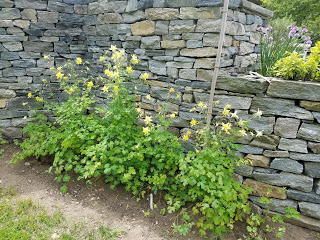
The nectar of Columbine, Aquilegia, is favored by Hummingbirds, Bumble Bees and Hawkmoths. Different species possess varying lengths of nectar spurs for specific pollinators.
The Red Buckeye, Aesculus pavia, attracts Hummingbirds, Butterflies, Bumble bees and Carpenter bees in the Spring.
Weigela, is a deciduous shrub with tubular flowers that attract Hummingbirds and various bees. In this photo there is also Aquilegia, far left middle. Other excellent sources of nectar and pollen include the Red Bud, Cercis canadensis, an early bloomer which flowers on bare wood before the leaves emerge (center top)
and Dogwood, Cornus ( far right).
Above, Honeysuckle Lonicera 'Dropmore Scarlet', a Hummingbird favorite, flowers at the same time as Beauty Bush, Kolkwitzia amabilis (background).
Ninebark, Physocarpus opulifolius, 'Diablo' on the left, 'Darts Gold' right, is also a valuable nectar source for pollinators, including native bees.
it is underplanted with Catmint, Nepeta, 'Six Hills Giant', a bumble bee magnet.
A veritable smorgasbord for pollinators, (left to right)
Philadelphus, Physocarpus, Paeonies, Potentilla, Verbena, Nepeta, Echinops, Iris, Caryopteris, Malus.
While the Mock Orange, Philadelphus coronarius, center, has yet to open its buds, the False Indigo, Baptisia australis, far left is open for business.
The Sage, Salvia nemerosa, (foreground), is certainly beneficial to pollinators. The Rose, (center) and Tradescantia, (background) less so.
Nepeta, (center), Cotinus (left), and Weigela (right) are constantly visited by bees and birds.
A drift of Bee Balm, Monarda, is a patch where Hummingbirds, Butterflies and Bees continually vie for the rich supply of nectar.
The pink Spirea, blue Geranium and even the orange Kniphofia, are all good sources of pollen and/or nectar a bit later in the season.
Rudbeckia never fails to attract a multitude of pollinators.
Monarda, Echinacea, Heliopsis and Agastache are insect magnets.
What more could a bee ask for.

 Posts
Posts