Search This Blog

Showing posts with label pollinators. Show all posts

Monday, May 14, 2018

Feed the pollinators: Fruit Garden


The early blooming apricots, are susceptible to late frost or a lack of pollinators. With the prolonged cool weather throughout April, it was the very end of the month before the flowers opened. The last frost was a week past and the pollinators were out and about. Hopefully there will be plenty of fruit to share with the squirrels, birds etc. 


The nectarine is usually the next to flower, being self fertile, only one tree is needed to ensure fruit.


To have any chance of a cherry harvest, netting the trees to prevent bird predation is essential.


For cross pollination, we have two varieties


The peach, this one given to us by a neighbour as a seedling he germinated from a pit, always flowers reliably and sets fruit. 


After waiting five years, this is the first time our Damson plum tree has flowered and only half a dozen or so at that. Not enough to make a whole lot of jam, but there is always next year.


Our Asian pear is only four years old and this is the second year of flowering. The fruits have to be thinned to get reliably good sized fruit.


The Bartlett pear will quickly grow to a formidable size and the fruit unreachable, unless pruned regularly.


Best to keep it confined to a bottle.


The 14 espaliered apples which surround the enclosed fruit garden were bought as whips and trained along the fence. A time consuming, but worthwhile endeavour. 


Each espalier is a different variety of apple, resulting in a varied display of flowers and fruits.


 Inside the enclosed fruit garden, we cultivate black currants,


red currants


and gooseberries,

  
 along with blueberries, which are presently flowering.


 Raspberries


and blackberries complete the cycle.


Saturday, February 17, 2018

Feeding the pollinators: the flower gardens at Stonewell Farm.


The Sunflower, Helianthus, is a native of N. America, and to my mind, the epitome of a summers day.
Rich in pollen and nectar for all manner of pollinators, 
it later provides oil rich seeds for birds and mammals.


The eastern Skunk Cabbage, Symplocarpus foetidus, is one of the earliest pollen producers,


here providing an ample supply of pollen to this honey bee.


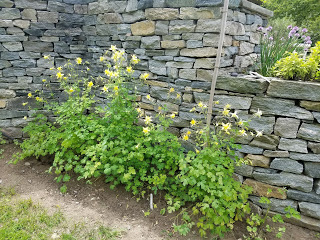
The nectar of Columbine, Aquilegia, is favored by Hummingbirds, Bumble Bees and Hawkmoths. Different species possess varying lengths of nectar spurs for specific pollinators.


The Red Buckeye, Aesculus pavia,  attracts Hummingbirds, Butterflies, Bumble bees and Carpenter bees in the Spring.


Weigela, is a deciduous shrub with tubular flowers that attract Hummingbirds and various bees. In this photo there is also Aquilegia, far left middle. Other excellent sources of nectar and pollen include the Red Bud, Cercis canadensis, an early bloomer which flowers on bare wood before the leaves emerge (center top)
and Dogwood, Cornus ( far right).


Above, Honeysuckle Lonicera 'Dropmore Scarlet', a Hummingbird favorite, flowers at the same time as Beauty Bush, Kolkwitzia amabilis (background).


Ninebark, Physocarpus opulifolius, 'Diablo' on the left, 'Darts Gold' right, is also a valuable nectar source for pollinators, including native bees.
it is underplanted with Catmint, Nepeta, 'Six Hills Giant', a bumble bee magnet.


A veritable smorgasbord for pollinators, (left to right)
Philadelphus, Physocarpus, Paeonies, Potentilla, Verbena, Nepeta, Echinops, Iris, Caryopteris, Malus.


While the Mock Orange, Philadelphus coronarius, center, has yet to open its buds, the False Indigo, Baptisia australis, far left is open for business.


The Sage, Salvia nemerosa, (foreground), is certainly beneficial to pollinators. The Rose, (center) and Tradescantia, (background) less so.


Nepeta, (center), Cotinus  (left), and Weigela (right) are constantly visited by bees and birds.


A drift of Bee Balm, Monarda, is a patch where Hummingbirds, Butterflies and Bees continually vie for the rich supply of nectar.


The pink Spirea, blue Geranium and even the orange Kniphofia, are all good sources of pollen and/or nectar a bit later in the season.


Rudbeckia never fails to attract a multitude of pollinators.


Monarda, Echinacea, Heliopsis and Agastache are insect magnets. 
What more could a bee ask for.