Search This Blog

Showing posts with label Rose. Show all posts

Sunday, May 27, 2018

Propagation

I layered this oak leaf hydrangea last fall. over the winter the stem has produced roots and new leaf growth has emerged. I will leave it attached to the parent plant  until winter dormancy and then cut the old stem, dig up and replant.


This Spring I have layered several choice shrubs, including the Cotinus coggygria 'Royal Purple". First find a stem that can be bent to the ground without damage, then wound the stem by scraping away the outer layer of bark to expose the green cambium layer.


Scrape a channel in the soil, bury the wounded area of the stem, cover with soil and weigh down with a medium size stone, or other similar weight.


Other shrubs that we are layering.
Duetzia


Duetzia, right foreground


Rosa Rugosa


 worth propagating for its fragrance.


Viburnum horizontalis


Here past its best, but still an exceptional shrub.


Weigela


Sometimes no assistance is required, if the stem is resting on the ground it will produce roots as with this Cotinus.
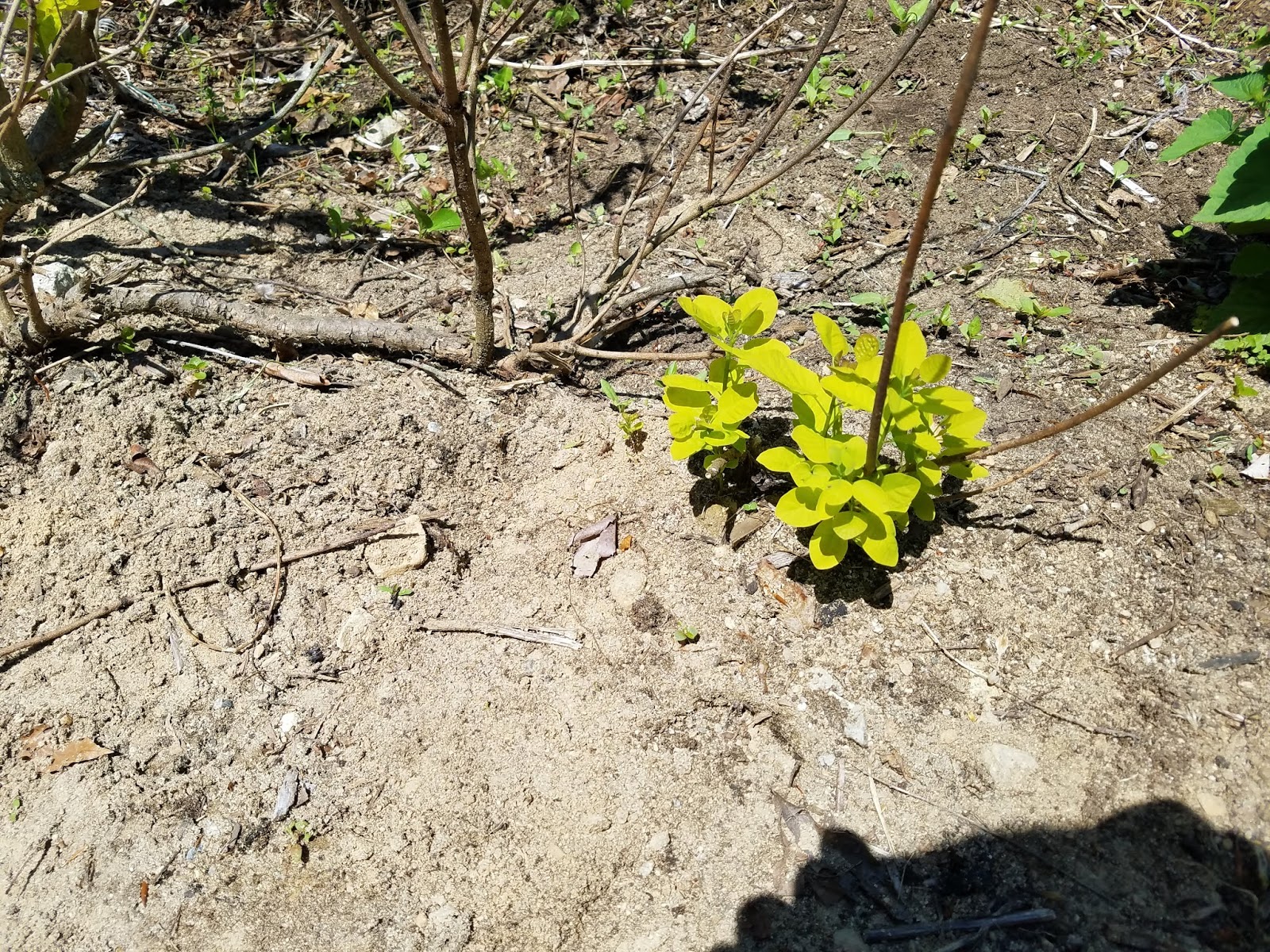

This self sown seedling is of a different Wigela cultivar, but it may not come true to type.


These seedlings from the spirea back center may also show variations from the parent plant


At first I thought this must be a seedling from the parent rose


But it is an off shoot from a root. I've never seen this before on a rose.


Wednesday, March 28, 2018

Voles and chewed root balls.

Now that the snow is clearing, the vole damage becomes apparent. The voles have eaten  the roots of this rose to the point where the weight of snow and wind has upended the plant, exposing the rootless crown.


I did manage to collect some cuttings which I have placed in a jar of water, along with some willow stems to encourage rooting.


This Hellebore suffered the same fate last fall, I potted a couple of sections that still had roots and after over-wintering in the greenhouse are now ready to be planted out as soon as the weather allows.


The four stems (below) are all that was left of this rose, to which I applied rooting compound and potted back in November. they spent the winter in the greenhouse to encourage root growth. Three have survived, which I will pot on this spring and replant in the garden 12 months from now.


If you find a hole next to a hosta plant it is almost certain to be a vole


They will eat the roots and then pull the whole plant below ground one leaf at a time, until there is nothing left.


Root vegetables like these beets are also at risk, along with potatoes, carrot etc


Encouraging predators into the garden, birds, for above ground hunting


and snake for below


will hopefully keep these little critters at a manageable level.


Thursday, January 21, 2016

The Fruiting Orchard

Several years ago, we took the decision  to remove a row of mature Eastern red cedar trees, (they are actually Junipers -Juniperus virginiana) after failing to control Cedar apple rust
Cedar apple rust on Juniperus virginiana
on our four, poorly performing apple trees, destined to become three after the largest tree succumbed to a prolonged wet spell followed by strong winds, and toppled. At the same time, we also decided to enlarge our orchard and fruit garden. So, at this time of year, when our gardening activities are often limited to poring over seed and plant catalogues, we are also pruning our established fruit trees, and formative pruning our new stock.

Our established fruit trees, which were already mature when we acquired the property, consist of three apples, only one of which we are sure of its progeny, (Red delicious) and two pear trees almost certainly Bartlett's, Oh, and one branch on an almost dead Peach tree which produced one peach and then promptly gave up the ghost, to be grubbed out and replaced by an Atlas cedar at the the north east corner of the orchard.  And, while not being productive of edible fruit, the Cedrus Atlantica, will with its majestic growth, nevertheless, feed the soul.
Fruiting Quince Cydonia oblonga

By removing the Eastern red cedars, we've been able to expand our choice of fruit trees within the orchard and ornamental flowering trees without. Plants within the Rose (Rosaceae) family, of which apples are one, are susceptible to Cedar apple rust. Of these, the ones grown primarily for their edible fruit include Apples, Pears, Peaches, Plums, Apricots, Nectarines, Cherries, Blackberries, Raspberries, Strawberries and Quince (Cydonia oblonga),
all of which we grow in our orchard and fruit garden, along with Persimmon, Mulberry, Blueberry, Gooseberry, Grape, and Currants (Black, Red and White).

 Quince (Chaenomeles japonica, and others) the flowering shrub,is also in the Rose family and now happily grows in our flower gardens along with other Rose family members, Hawthorn, Serviceberry and of course the Rose itself in all its glorious guises.
Flowering Quince Chaenomeles japonica

I started this post with the intention of writing about the pruning of fruiting plants, ah well, next time.